Born in New York and raised in Tokyo, Chris transitioned into broadcasting and analysis after retiring as a player. Known for his clear delivery and data-driven insights, he now works as a commentator, reporter, simultaneous interpreter, and writer.
The Western Conference semifinals were tied 2–2. Historically, the winner of Game 5 in that scenario advances 84.2 percent of the time.
The Spurs played like they understood exactly what was at stake. From the opening tip inside the Frost Bank Center, San Antonio imposed its will — through Victor Wembanyama's bounce-back performance, relentless paint pressure, and a level of composure that felt far beyond the age of its core.
The final score read 126–97, but the game itself revealed something larger: a young team beginning to understand how to win at the highest level.
Seven years removed from their last meaningful postseason run, the Spurs are now one win away from the Western Conference Finals.
Wembanyama’s Answer
Two days after his Flagrant 2 ejection in Game 4, Wembanyama delivered the response expected from a franchise cornerstone.
He exploded for 16 points in the opening six minutes and finished the first half with 21 points and 11 rebounds — becoming the first Spurs player since Tim Duncan to record a playoff first-half double-double for the franchise.
The scale of his offensive gravity remains almost impossible to contextualize. He scored from everywhere: above the rim, behind the arc, in transition, and through contact. San Antonio built a 15-point lead and entered halftime ahead 59–47. Yet what stood out most afterward was not the stat line.
"We did what we were supposed to do at home," Wembanyama said postgame. "But the job's not finished. I want to get one more win."
The quote reflected the tone of the entire night. Even after a dominant performance, Wembanyama spoke not about domination, but process. And nowhere was that mentality tested more than in the third quarter.
The Meaning of Staying Calm
Minnesota opened the second half aggressively.
Using a series of Chicago actions — pairing Rudy Gobert handoffs with Anthony Edwards’ off-ball movement — the Timberwolves immediately generated a 7–0 run and cut the deficit from 12 points to just two.
In previous years, this might have been the moment a young Spurs team unraveled.
Instead, San Antonio responded with maturity.
One timeout settled the game. From there, the Spurs closed the third quarter on a devastating 30–12 run.
Wembanyama scored only three points during that stretch, but San Antonio’s identity never wavered. Keldon Johnson, who had averaged just 8.8 points entering the game, finished with 21 — eight of which came in the third quarter alone.
Stephon Castle relentlessly attacked the paint. Rookie guard Harper added six points of his own.By the end of the quarter, the Spurs had created a staggering 20–8 advantage in paint scoring during the period alone.
After the game, Timberwolves head coach Chris Finch summarized the collapse bluntly:
“Our defense just cratered. We gave up 30 points, I think, in the last six minutes of the third quarter. A lot of it was just ball contain stuff.”
That phrase — “ball contain” — became the defining tactical theme of the night.
Minnesota simply could not stop San Antonio’s dribble penetration.
A Drive Game That Overwhelmed Minnesota
Throughout the regular season, San Antonio’s perimeter attack, combined with Wembanyama's gravity, consistently pressured defenses downhill. In this series, that identity has become overwhelming.
This was not one superstar tearing through a defense alone.
It felt more like a meteor shower.
Wave after wave of Spurs ball handlers attacked from different angles, forcing Minnesota’s defense into constant rotation. Wembanyama’s gravity bent the floor so dramatically that secondary attackers repeatedly found clean driving lanes.
Castle, in particular, played with remarkable force.
Whether attacking switches, exploding out of semi-transition actions, or flowing into double-high pick-and-rolls, he repeatedly broke Minnesota’s perimeter containment. One sequence midway through the third quarter perfectly captured the Spurs’ offensive structure: a “77 Get” action initiated near the sideline created enough confusion that neither Gobert nor the weak-side help could rotate in time once Castle gained momentum downhill.
The spacing was pristine. The timing was ruthless.
And once Minnesota began scrambling, San Antonio punished every mistake in transition.
The Numbers That Explain the Series
For most of this series, the central question has been:
“How do you guard Wembanyama?”
But Game 5 suggested Minnesota may now be facing a more dangerous reality:
They no longer have answers for San Antonio’s entire ecosystem.
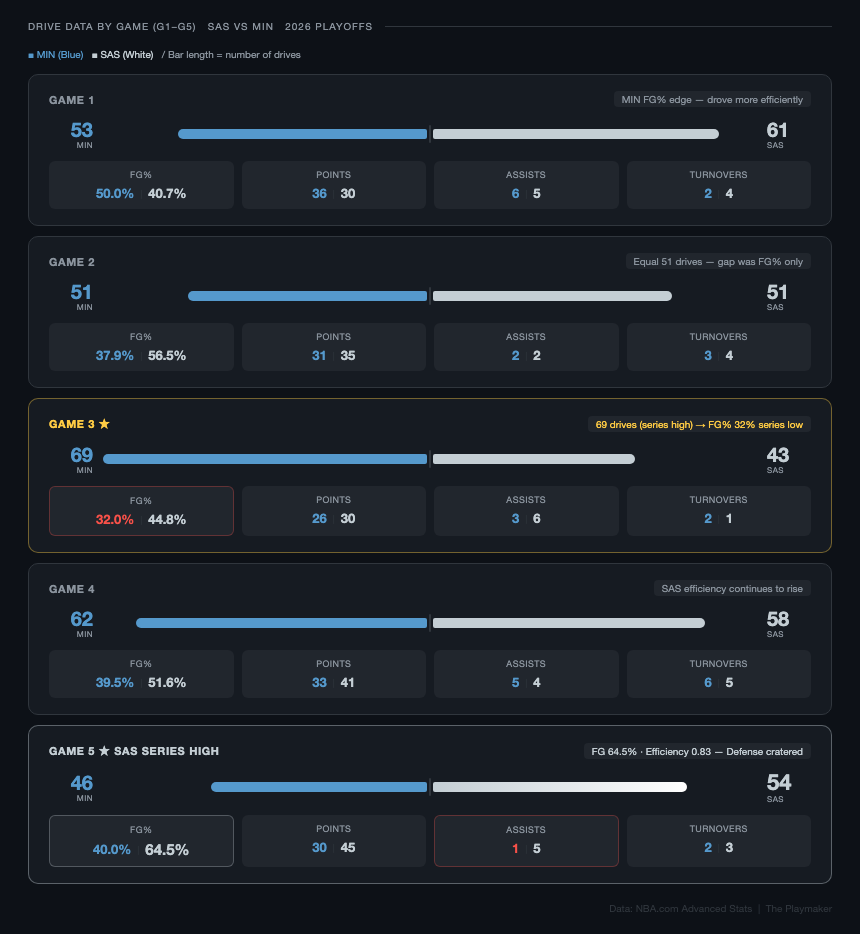
The drive numbers tell the story clearly.
San Antonio converted 64.5 percent of its field-goal attempts directly out of drives — its highest rate of the series. More importantly, the Spurs’ points per drive have steadily increased game by game, suggesting Minnesota’s defensive structure is deteriorating over time rather than improving.
Born in New York and raised in Tokyo, Chris transitioned into broadcasting and analysis after retiring as a player. Known for his clear delivery and data-driven insights, he now works as a commentator, reporter, simultaneous interpreter, and writer.
A writer for The Playmaker, I coach players and study the game through player development and basketball theory. I collaborate with Chris Sasaki on media and analysis projects, delivering clear, practical insights for both players and fans.
A writer for The Playmaker, I coach players and study the game through player development and basketball theory. I collaborate with Chris Sasaki on media and analysis projects, delivering clear, practical insights for both players and fans.
A writer for The Playmaker, I coach players and study the game through player development and basketball theory. I collaborate with Chris Sasaki on media and analysis projects, delivering clear, practical insights for both players and fans.
A writer for The Playmaker, I coach players and study the game through player development and basketball theory. I collaborate with Chris Sasaki on media and analysis projects, delivering clear, practical insights for both players and fans.
A writer for The Playmaker, I coach players and study the game through player development and basketball theory. I collaborate with Chris Sasaki on media and analysis projects, delivering clear, practical insights for both players and fans.
A writer for The Playmaker, I coach players and study the game through player development and basketball theory. I collaborate with Chris Sasaki on media and analysis projects, delivering clear, practical insights for both players and fans.
A writer for The Playmaker, I coach players and study the game through player development and basketball theory. I collaborate with Chris Sasaki on media and analysis projects, delivering clear, practical insights for both players and fans.
A writer for The Playmaker, I coach players and study the game through player development and basketball theory. I collaborate with Chris Sasaki on media and analysis projects, delivering clear, practical insights for both players and fans.
A writer for The Playmaker, I coach players and study the game through player development and basketball theory. I collaborate with Chris Sasaki on media and analysis projects, delivering clear, practical insights for both players and fans.
A writer for The Playmaker, I coach players and study the game through player development and basketball theory. I collaborate with Chris Sasaki on media and analysis projects, delivering clear, practical insights for both players and fans.
A writer for The Playmaker, I coach players and study the game through player development and basketball theory. I collaborate with Chris Sasaki on media and analysis projects, delivering clear, practical insights for both players and fans.
A writer for The Playmaker, I coach players and study the game through player development and basketball theory. I collaborate with Chris Sasaki on media and analysis projects, delivering clear, practical insights for both players and fans.
Born in New York and raised in Tokyo, Chris transitioned into broadcasting and analysis after retiring as a player. Known for his clear delivery and data-driven insights, he now works as a commentator, reporter, simultaneous interpreter, and writer.
Born in New York and raised in Tokyo, Chris transitioned into broadcasting and analysis after retiring as a player. Known for his clear delivery and data-driven insights, he now works as a commentator, reporter, simultaneous interpreter, and writer.
A writer for The Playmaker, I coach players and study the game through player development and basketball theory. I collaborate with Chris Sasaki on media and analysis projects, delivering clear, practical insights for both players and fans.
A writer for The Playmaker, I coach players and study the game through player development and basketball theory. I collaborate with Chris Sasaki on media and analysis projects, delivering clear, practical insights for both players and fans.




![“The Pursuit of Perfection” — Young Spurs One Win Away from the Western Conference Finals | Chris’s Court Vision [5/14]](https://storage.ghost.io/c/67/43/674316a6-b72f-4abb-a35b-bd0c87956497/content/images/size/w2000/format/webp/2026/05/ccv-SAS-MIN-en.jpg)