Born in New York and raised in Tokyo, Chris transitioned into broadcasting and analysis after retiring as a player. Known for his clear delivery and data-driven insights, he now works as a commentator, reporter, simultaneous interpreter, and writer.
No matter how loudly parity was proclaimed heading into the 2026-27 campaign, opening night seemed to reaffirm a familiar truth: the Oklahoma City Thunder remained the undisputed benchmark of the association.
Yet, fate is rarely linear. A devastating injury to J-Dub (Jalen Williams), paired with a shoulder issue sidelining newly minted starter Cason Wallace and a two-month knee rehab timeline for Chet Holmgren, has abruptly fractured OKC’s early-season dominance. With the Houston Rockets and Portland Trail Blazers bolting out of the gates, the Western Conference has been thrust into an authentic, wide-open war of attrition.
Standing at the epicenter of this newly chaotic landscape are the San Antonio Spurs and their audacious tactical experiment: a starting lineup deploying De'Aaron Fox, Stephon Castle, and sophomore Dylan Harper in tandem—a modern "Three Musketeers" backcourt predicated on relentless rim pressure.
Just months removed from storming into hostile territory to claim Game 7 of the Western Conference Finals and breathing the rarefied air of the 2026 NBA Finals, the Spurs explicitly rejected complacency. By surrounding Victor Wembanyama with Devin Vassell and three dynamic ball-handlers, San Antonio is daring to explore the absolute upper ceiling of positional size and playmaking. It is an ambitious pursuit of basketball’s modern holy grail: fielding a lineup that effectively functions as five two-meter point guards.
Yet, benching Julian Champagnie—the premier spacer who underpinned their second-half surge a year ago—invited immediate skepticism. Historically, Fox, Castle, and Harper have never commanded respect as elite perimeter marksmen, presenting a glaring structural dilemma: does this configuration suffocate the operational airspace of the alien himself, Victor Wembanyama?
Head coach Mitch Johnson was acutely mindful of this volatility last season. Across the entire 2025-26 regular season, NBA Cup, and postseason run, Johnson deployed the trio together for a meager 72 total minutes—a stretch where San Antonio was outscored by 23 points (-23 plus-minus).
Eight games into the 2026-27 campaign, however, that dynamic has been turned on its head. The trio has already logged 90 minutes together, boasting an eye-popping +56 differential.
Surface numbers suggest a revolutionary triumph. But as analyst, my responsibility is to untangle the underlying context rather than capitulate to small-sample euphoria.
First and foremost: despite starting each half together, the three guards share the court for merely 11.2 minutes per contest. Factoring in an early overtime thriller, their concurrent floor time remains meticulously rationed. Coach Johnson is treating this look not as a blanket default, but as a high-octane shock weapon.
When we examine the advanced metrics, the revelation becomes startlingly clear. During their shared minutes, the Spurs post an offensive rating of 115.8, a defensive rating of 86.8, and a staggering net rating of +29.0.
A 115.8 ORTG hovers only slightly above league-average efficiency. The true engine of this +29.0 juggernaut is not an unstoppable half-court offense—it is an all-smothering, suffocating defensive enterprise.
With Vassell offering switchable length and Wembanyama functioning as the ultimate deterrent, this is effectively a four-guard defense. The ferocious point-of-attack harassment from Castle and Harper, coupled with their guard-defying rebounding vigor and Fox’s predatory passing-lane instincts, establishes a defensive perimeter that plays vastly bigger than its roster listings. Anchored by the reigning unanimous Defensive Player of the Year, whose league-leading 4.5 blocks per game effectively erase the paint, San Antonio’s guards are empowered to play with unapologetic defensive aggression.
And from that defensive grit springs their signature weapon: transition offense.
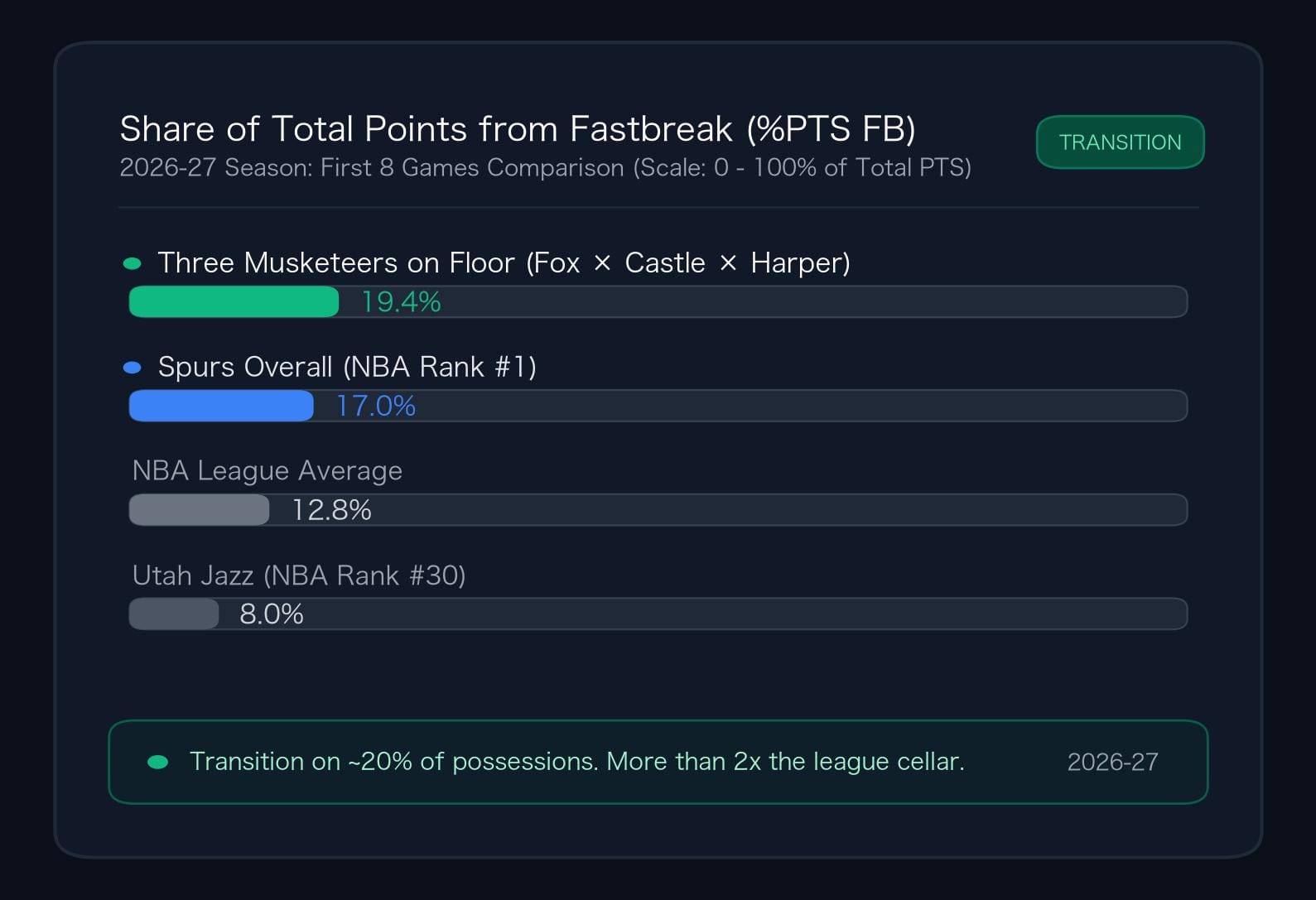
Through eight games, the Spurs execute a transition attack on nearly 20% of their possessions. Fast break points account for 17.0% of their total scoring—the highest rate in the NBA, more than double the cellar-dwelling Utah Jazz (8.0%), and comfortably ahead of the league average (12.8%).
When Fox, Castle, and Harper share the floor, that fast break scoring ratio surges to an astounding 19.4%. San Antonio has elevated its overall transition output from 27.7 points per game last season to 29.5 points today.
Furthermore, context dictates another vital reality: every single second the Three Musketeers have logged together this season has been played alongside Wembanyama. Luke Kornet has not shared the floor with the trio for a single possession. Wembanyama’s on/off court net rating (+21.2 on / -14.7 off) confirms that the young guard tandem functions inside the protective thermal shield of a transcendent superstar.
Yet, if one summons the bitter memory of the 2026 NBA Finals—where the Spurs pushed the New York Knicks to the brink before succumbing in grueling physical fashion—the core ailment was undeniable: half-court offensive execution.
When confronted by an opponent possessing the physical stature and disciplined interior integrity to absorb human hurricanes, can this current iteration of the Spurs prevail?
We cannot flinch from the reality that San Antonio’s scorching start remains precariously tethered to early-offense adrenaline.
On October 28 against Utah, Harper was benched late in the fourth quarter. It was a telltale signal: feeling the suffocating contraction of half-court spacing, Coach Johnson was forced to intervene. (That Johnson re-inserted Harper for overtime—and Harper rewarded that trust with exceptional shot-creation—only underscores both the immense expectations placed upon him and his extraordinary poise).
Why do the Spurs find their half-court offense grasping for oxygen? To understand the tactical chess match, we must examine the defensive blueprints designed to neutralize Victor Wembanyama, the mathematical tax of the non-shooter, and the high-level schematic battles surrounding switches and the Spain Pick-and-Roll.
Born in New York and raised in Tokyo, Chris transitioned into broadcasting and analysis after retiring as a player. Known for his clear delivery and data-driven insights, he now works as a commentator, reporter, simultaneous interpreter, and writer.
A writer for The Playmaker, I coach players and study the game through player development and basketball theory. I collaborate with Chris Sasaki on media and analysis projects, delivering clear, practical insights for both players and fans.
A writer for The Playmaker, I coach players and study the game through player development and basketball theory. I collaborate with Chris Sasaki on media and analysis projects, delivering clear, practical insights for both players and fans.
A writer for The Playmaker, I coach players and study the game through player development and basketball theory. I collaborate with Chris Sasaki on media and analysis projects, delivering clear, practical insights for both players and fans.
A writer for The Playmaker, I coach players and study the game through player development and basketball theory. I collaborate with Chris Sasaki on media and analysis projects, delivering clear, practical insights for both players and fans.
A writer for The Playmaker, I coach players and study the game through player development and basketball theory. I collaborate with Chris Sasaki on media and analysis projects, delivering clear, practical insights for both players and fans.
A writer for The Playmaker, I coach players and study the game through player development and basketball theory. I collaborate with Chris Sasaki on media and analysis projects, delivering clear, practical insights for both players and fans.
A writer for The Playmaker, I coach players and study the game through player development and basketball theory. I collaborate with Chris Sasaki on media and analysis projects, delivering clear, practical insights for both players and fans.
A writer for The Playmaker, I coach players and study the game through player development and basketball theory. I collaborate with Chris Sasaki on media and analysis projects, delivering clear, practical insights for both players and fans.
A writer for The Playmaker, I coach players and study the game through player development and basketball theory. I collaborate with Chris Sasaki on media and analysis projects, delivering clear, practical insights for both players and fans.
A writer for The Playmaker, I coach players and study the game through player development and basketball theory. I collaborate with Chris Sasaki on media and analysis projects, delivering clear, practical insights for both players and fans.
A writer for The Playmaker, I coach players and study the game through player development and basketball theory. I collaborate with Chris Sasaki on media and analysis projects, delivering clear, practical insights for both players and fans.
A writer for The Playmaker, I coach players and study the game through player development and basketball theory. I collaborate with Chris Sasaki on media and analysis projects, delivering clear, practical insights for both players and fans.
A writer for The Playmaker, I coach players and study the game through player development and basketball theory. I collaborate with Chris Sasaki on media and analysis projects, delivering clear, practical insights for both players and fans.
A writer for The Playmaker, I coach players and study the game through player development and basketball theory. I collaborate with Chris Sasaki on media and analysis projects, delivering clear, practical insights for both players and fans.